Settings → Returns
One row per return track in your export: its letter, color, name, the stem groups, stems and tracks that feed it, whether it loads on or muted, and where it outputs. Rename, recolor, add and remove sources, turn returns on or mute them, change outputs, and remove or restore returns.
Settings → Returns is the last of the three routing screens. Stems belong to stem groups, stem groups land on returns, and this page is the returns: what each one is called, what feeds it, and where it goes in Live. It shows every return your template ships, including the ones nothing lands on yet.
Returns are the output destination. Stem groups are separate — renaming a return does not rematch groups by name, and a custom group whose name matches a return still needs Routes to set on Settings → Stem groups.
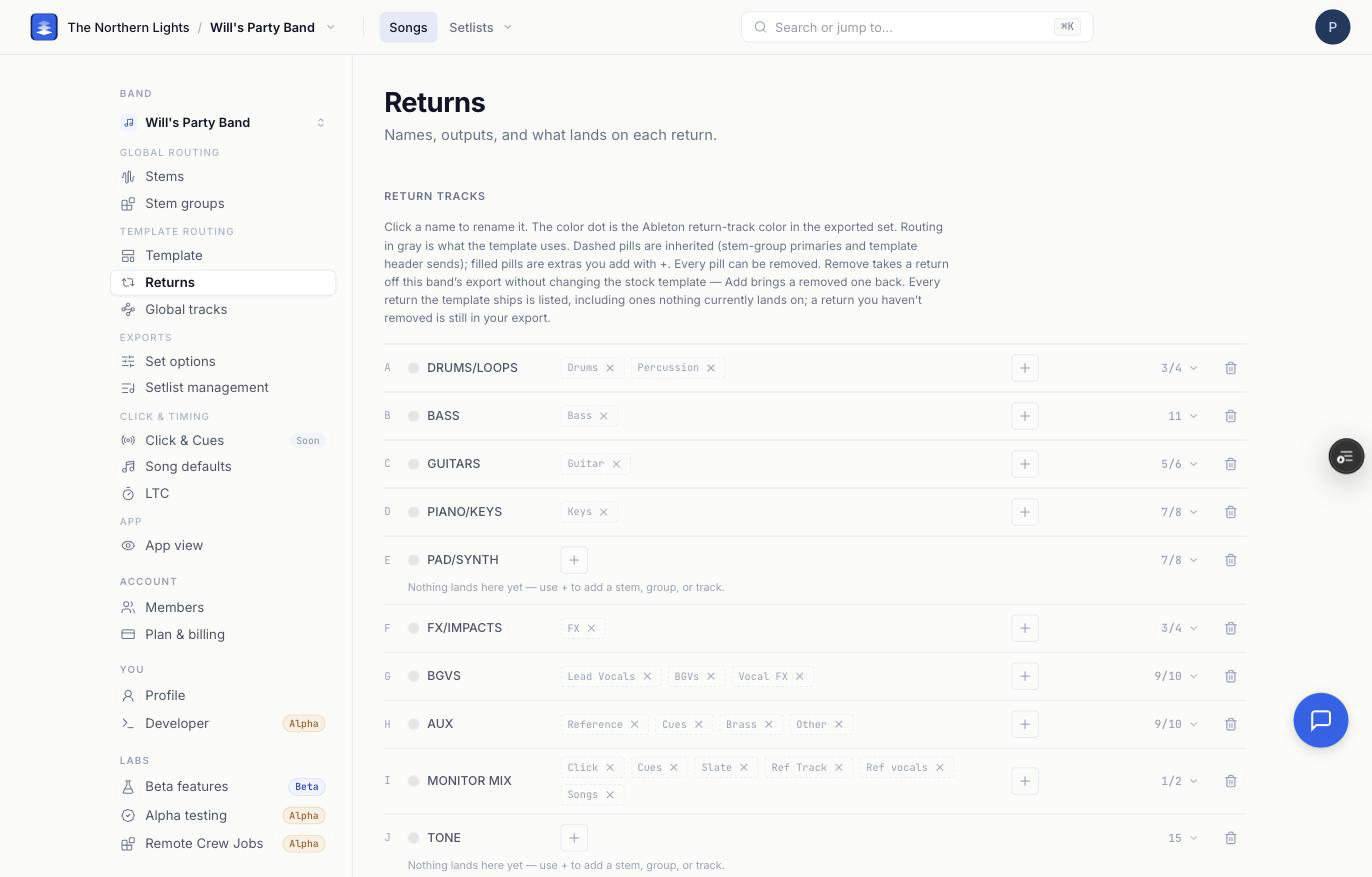
One row per return
Left to right, each row gives you:
- The letter. A through L, matching the return's position in the exported Live Set.
- The color dot. Click it to pick the Ableton return-track color from the palette.
- The name. Click it to rename. The new name is what appears in the exported
.als. The toast confirmsA → New name. - Source pills. What lands on this return. Dashed pills are inherited: a stem group whose primary return is this one, or a header-track send the template itself makes. Filled pills are extras you added with +. Every pill has an × and every pill can be removed.
- +. Adds a source. The menu has three lists: Stem group, Tracks (the template's header tracks, plus Songs), and Specific stem (every stem name in the band). Anything already on the return is left out of the list.
- The on/muted switch. Whether the return sounds when the exported set opens. On means the return is on; off means it loads muted, and the label reads Muted. It starts at whatever your template does, and changing it applies to this band's exports from then on.
- The output. Where the return goes in Live. Gray means it is what the template does; solid means you have overridden it.
- The trash icon. Removes the return from this band's export.
A return with nothing on it reads "Nothing lands here yet — use + to add a stem, group, or track." It is still in your export. Only the trash icon takes a return out.
Not routed
At the top of the page, Not routed lists stem groups that aren't on any return yet. Stems in those groups get no return routing when you export. Custom stem groups start here, because Pliris doesn't guess where you want them. Drag each group onto a return, or add it to a return with +. Check this list is empty before you export.
Sources: what can feed a return
Three kinds of thing, and a return can carry any mix of them:
| Source | What it means in the export |
|---|---|
| Stem group | Every stem in that group gets a send to this return, in every song. |
| Tracks | A header track (Click, Cues, Slate, Ref Track, Songs and the rest) sends to this return. |
| Specific stem | Every stem with that exact name, in every song, gets a send to this return, whatever group it is in. |
Removing an inherited group pill stops that group sending here. If this was the group's primary return, its Routes to on Stem groups is cleared too, so give it a new home there. Adding a source back with + lifts the removal.
This is what makes multi-return routing possible: one stem is in exactly one group, but it can land on as many returns as you like. The walkthrough is Routing One Stem to Multiple Return Tracks.
On or muted
Every return starts at the state your template gives it. On Playback Pro that means every return is on except I (MONITOR MIX), which ships muted. If you have repurposed return I for your own bus, for example renamed it and routed a stem group to it, turn its switch on so it sounds in the exported set.
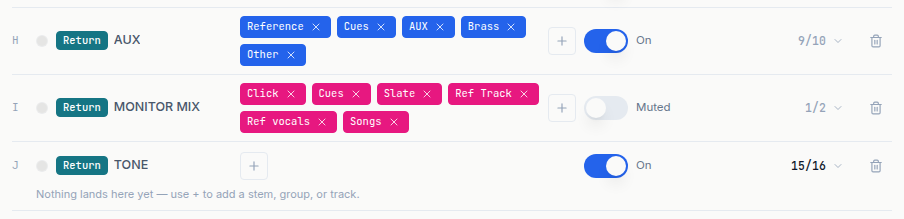
Removing the Songs pill from a return also stops each song's folder sending to it. On Pro, every song folder sends to return I by default. If you have taken return I for your own bus, remove Songs from it so the stems you route there are not doubled by the folder send.
Output
Click the output value to change where the return goes. The picker offers:
- Sends only and No output.
- Internal routing…, which reveals a second picker of the template's own tracks so a return can feed a track inside the set.
- Main (Live 12's name for the Master track), the stereo pairs 1/2 through 31/32, and the mono external outs 1 through 32.
Once overridden, Reset to template appears at the top of the picker and names the value it goes back to.
Remove and Add return
The trash icon removes a return from this band's export, on this template. Its sends, routing overrides and any group primaries pointing at it are cleared, but its name and color are kept so it comes back as it was. The stock template is untouched, and every other band still has it.
Add return (under the list, shown while at least one return is removed) lists the removed returns by letter and stock name. Pick one and it is restored to the same slot with the template's default output.
Everything on this page is saved per band and per template. Switch the band to a different template and you see that template's returns, with its own names, removals and sends.
For a job-by-job walkthrough, see Routing Return Tracks.
Frequently asked questions
How do I rename a return track in Pliris?
Open Settings → Returns and click the return's name. Type the new one and press Enter. That name is used in the exported Live Set. Renaming a return does not rematch stem groups by name — groups keep their existing Routes to until you change it on Settings → Stem groups.
What can I route to a return track?
Three kinds of source: a stem group (every stem in it), a track (a header track like Click, Cues or Slate), or a specific stem by name. Click + on the return and pick from the three lists. A return can carry any mix of them.
Why is a return with nothing on it still showing?
Because it is still in your export. The page lists every return the template ships so that "empty" and "removed" never look the same. Use the trash icon if you want it gone.
How do I change where a return track outputs?
Click the output value on the return's row and pick Main, a stereo pair, a mono external out, Sends only, No output, or Internal routing to one of the template's tracks. Gray means the template's own value; solid means yours. Reset to template undoes it.
Why is my return track muted in the exported Ableton set?
Your template ships it muted. On Playback Pro, return I (MONITOR MIX) loads muted. Open Settings → Returns and turn that return's switch on. The label changes from Muted to On, and every export from then on loads it unmuted.
I repurposed return I and my stems are doubled. Why?
Every song folder on Pro sends to return I by default, so a stem group routed there arrives twice: once from its own send and once through the folder. On Settings → Returns, remove the Songs pill from return I. The folder send then stays off and only your routed stems land there.
I removed a return. How do I get it back?
Click Add return under the list and pick the return by its letter. It comes back with its original name and color and the template's default output.